How Much Is Your Penny Worth?
Found an old British penny? It could be worth hundreds or even thousands of pounds!
Instant lookup for any year 1797–1967 • See potential values from £1 to £100,000+
Welcome to the Definitive British Penny Reference
From the massive "cartwheel" pennies of George III to the final bronze pennies of Elizabeth II, explore 260 years of British penny history.
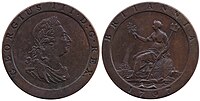
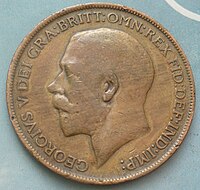
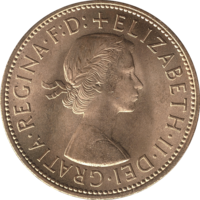
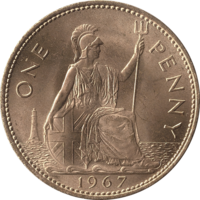
Images: Wikimedia Commons (CC BY-SA)
The Two Eras of British Pennies
Large Copper Pennies
The "old copper" pennies, ranging from 36mm cartwheels weighing a full ounce to the later 34mm issues. These substantial coins featured Britannia on the reverse and saw Britain through the Georgian era and early Victorian period.
Key highlights:
- 1797 "Cartwheel" Penny – Matthew Boulton's revolutionary design[1]
- Soho Mint innovations in steam-powered coining
- Transition from Tower Mint to Royal Mint production
Small Bronze Pennies
The iconic 31mm bronze penny, composed of 95% copper, 4% tin, and 1% zinc. This familiar design served Britain for over a century until decimalization replaced it with the "new penny."
Key highlights:
- 1860 transition from copper to bronze[2]
- 1933 Penny – Britain's rarest circulation coin
- World War alterations and emergency issues
Historical Timeline
Acts of Union create the Kingdom of Great Britain. Copper pennies continue under Queen Anne, though penny production was sporadic.[3]
Matthew Boulton's Soho Mint produces the famous "Cartwheel" penny and twopence, the first British coins struck by steam power. At 28.3g (1 oz), these remain the heaviest British pennies ever minted.[1]
Soho Mint produces lighter copper pennies (18.8g) for George III, establishing the design template for decades.
First pennies struck at the new Royal Mint on Tower Hill, London, replacing the ancient Tower of London facility.[1]
Victoria's copper penny series begins, featuring the "young head" portrait by William Wyon.
The Great Transition: Bronze replaces copper. The penny shrinks from 34mm to 31mm, and the modern "bun head" Victoria design debuts. This marks the beginning of the small penny era.[2]
"Old head" Victoria portrait introduced, the third and final design of her reign.
Edward VII penny debuts with the "low tide" variety – a sought-after early die state.
Emergency wartime pennies struck at branch mints: Heaton (H mintmark) and Kings Norton (KN).[4]
Only 6–7 pennies struck – exclusively for ceremonial purposes. The 1933 penny becomes Britain's most famous rarity, with specimens selling for over £100,000.[2]
Edward VIII abdicates before any pennies bearing his portrait enter circulation. Pattern pieces exist and are extremely rare.
George VI penny introduces a new Britannia design by Humphrey Paget.
Elizabeth II penny begins production. The 1953 issue includes both "proof" and business strike versions.
Final pre-decimal pennies struck. Over 650 million produced in anticipation of coin shortages during decimalization.
Decimal Day (15 February): The 240-pence pound gives way to the 100-pence pound. The old penny is demonetized, ending 1,000+ years of British penny tradition.[1]
Monarchs at a Glance
George III
Pennies: 1797–1807
The "Cartwheel" era. Includes the famous 1797 issue and later Soho Mint productions. Look for: sharp rim lettering, broad rim varieties.
George IV
Pennies: 1825–1827
First pennies from the new Royal Mint. Relatively short series with distinct portrait styles.
William IV
Pennies: 1831–1837
Scarce series with lower mintages. Key date: 1831 with W.W on truncation (William Wyon signature).
Victoria
Pennies: 1839–1901
The longest reign: copper young head (1839–1860), bronze bun head (1860–1894), bronze old head (1895–1901). Massive variety of dates and types.
Edward VII
Pennies: 1902–1910
Short but collectible series. Look for: 1902 "low tide" variety, higher grade survivors.
George V
Pennies: 1911–1936
Includes WWI branch mint issues (H and KN mintmarks) and key date 1933. Modified effigy in 1928.
Edward VIII
1936 (no circulation issues)
Abdicated before coins released. Only pattern pennies exist – among the rarest British coins.
George VI
Pennies: 1937–1952
New Britannia reverse design. Key dates: 1950 and 1951 (low mintage).
Elizabeth II
Pennies: 1953–1967
Final pre-decimal series. Mary Gillick portrait. 1953 proof sets highly collectible.
Most Valuable British Pennies
| Date | Type | Rarity | Estimated Value |
|---|---|---|---|
| 1933 | George V Bronze | Extremely Rare (6–7 known) | £100,000+ |
| 1936 | Edward VIII Pattern | Extremely Rare (patterns only) | £50,000+ |
| 1869 | Victoria Bronze | Rare | £3,000–15,000 |
| 1871 | Victoria Bronze | Rare | £2,000–10,000 |
| 1882H | Victoria Bronze (no H) | Rare variety | £2,000–8,000 |
| 1797 | Cartwheel Penny (proof) | Scarce | £1,500–5,000 |
| 1950 | George VI Bronze | Scarce | £30–150 |
| 1951 | George VI Bronze | Scarce | £20–100 |
| 1860 | Victoria Bronze (beaded border) | Collectible variety | £50–300 |
| 1902 | Edward VII "Low Tide" | Collectible variety | £25–150 |
Values are approximate and depend heavily on condition. See our Grading Guide for condition assessment.
Quick Reference: Specifications
Large Copper Pennies
| Attribute | 1797 Cartwheel | 1806–1860 |
|---|---|---|
| Diameter | 36mm | 34mm |
| Weight | 28.3g (1 oz) | 18.8g |
| Composition | Copper | Copper |
| Edge | Lettered | Plain |
Small Bronze Pennies
| Attribute | 1860–1967 |
|---|---|
| Diameter | 30.8mm |
| Weight | 9.4g |
| Composition | 95% Cu, 4% Sn, 1% Zn |
| Edge | Plain |
Primary Sources & References
- [1] The Royal Mint – Coin Design and Specifications
- [2] Spink & Son – Coins of England and the United Kingdom (Standard Catalogue)
- [3] British Museum – Coins and Medals Collection
- [4] Coincraft – Standard Catalogue of English and UK Coins
- [5] NGC Coin Explorer – United Kingdom
- [6] PCGS CoinFacts – World Coins
- [7] Numista – UK Penny Catalog
- [8] Coin Hunter – UK Coin Collecting Guide