Introduction to Small Bronze Pennies
In 1860, Britain made a fundamental change to its copper coinage: the large copper penny, which had served since 1797, gave way to a smaller bronze coin. This new penny would remain essentially unchanged in size and composition for over a century, until decimalization in 1971.[1]
Why the Change?
- Economics: Rising copper prices made the large penny uneconomical—its metal value approached its face value.
- Convenience: The lighter coin (9.4g vs 18.8g) was easier to carry and handle.
- Technology: Bronze (copper-tin-zinc alloy) proved more durable and resistant to wear.
- Counterfeiting: The precise bronze composition was harder to replicate than pure copper.
Standard Specifications (1860–1967)
| Attribute | Specification |
|---|---|
| Diameter | 30.8mm |
| Weight | 9.45g |
| Composition | 95% Copper, 4% Tin, 1% Zinc |
| Edge | Plain |
| Obverse | Monarch's portrait |
| Reverse | Britannia seated (varied designs) |
Victoria Bronze Pennies (1860–1901)
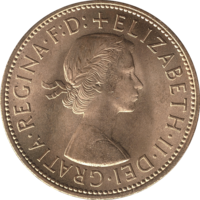
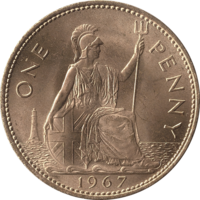
Images: Wikimedia Commons (CC BY-SA)
Queen Victoria's bronze penny series spans three distinct portrait types across 41 years—the longest penny series for any British monarch.[2]
Portrait Types
"Bun Head"
Named for Victoria's hairstyle worn in a "bun" at the back. Designed by Leonard Charles Wyon. The most common Victorian penny type.
Key varieties: Beaded border (1860), toothed border (1860-on), signature positions.
"Old Head" / "Veiled Head"
A mature portrait showing the elderly queen wearing a veil and small crown. Designed by Thomas Brock.
Key feature: "ONE PENNY" in linear format on reverse.
Beaded vs Toothed Border
The 1860 penny exists in two major varieties: beaded border (early) and toothed border (later). Both are collectible.
Bun Head Series (1860–1894)
| Date | Mintage (approx) | Rarity | Est. Value (VF) |
|---|---|---|---|
| 1860 Beaded | ~5,000,000 | Scarce | £50–200 |
| 1860 Toothed | ~35,000,000 | Common | £10–30 |
| 1861 | 36,449,280 | Common | £8–25 |
| 1862 | 50,534,400 | Common | £6–20 |
| 1863 | 28,062,720 | Common | £8–25 |
| 1864 | 3,440,640 | Scarce | £25–80 |
| 1865 | 8,601,600 | Common | £12–35 |
| 1866 | 9,999,360 | Common | £10–30 |
| 1867 | 5,483,520 | Scarce | £20–60 |
| 1868 | 1,182,720 | Rare | £80–250 |
| 1869 | 2,580,480 | Key Date | £200–800 |
| 1870 | 5,695,025 | Scarce | £30–100 |
| 1871 | 1,290,318 | Key Date | £150–500 |
| 1872 | 8,494,572 | Common | £10–30 |
| 1873 | 8,494,200 | Common | £10–30 |
| 1874 | 5,621,865 | Common | £12–35 |
| 1874H | Included | Scarce | £30–100 |
| 1875 | 10,691,040 | Common | £8–25 |
| 1875H | 752,640 | Scarce | £35–120 |
| 1876H | 1,175,200 | Scarce | £25–80 |
| 1877 | 9,624,747 | Common | £8–25 |
| 1878 | 2,764,470 | Scarce | £20–60 |
| 1879 | 7,666,476 | Common | £10–30 |
| 1880 | 3,000,831 | Scarce | £18–50 |
| 1881 | 2,302,362 | Scarce | £20–60 |
| 1881H | 1,792,000 | Scarce | £25–80 |
| 1882H | 7,526,400 | Common | £10–30 |
| 1882H no H | Unknown | Rare variety | £500–2,000 |
| 1883 | 6,237,438 | Common | £8–25 |
| 1884 | 11,702,802 | Common | £6–20 |
| 1885 | 7,145,862 | Common | £8–25 |
| 1886 | 6,087,759 | Common | £8–25 |
| 1887 | 5,315,085 | Common | £8–25 |
| 1888 | 5,125,020 | Common | £8–25 |
| 1889 | 12,559,737 | Common | £6–20 |
| 1890 | 15,330,840 | Common | £6–20 |
| 1891 | 17,885,961 | Common | £6–18 |
| 1892 | 10,501,671 | Common | £6–20 |
| 1893 | 8,161,737 | Common | £6–20 |
| 1894 | 3,883,452 | Scarce | £15–45 |
Old Head Series (1895–1901)
| Date | Mintage | Rarity | Est. Value (VF) |
|---|---|---|---|
| 1895 | 5,395,830 | Common | £6–20 |
| 1896 | 24,147,156 | Common | £4–15 |
| 1897 | 20,756,620 | Common | £4–15 |
| 1898 | 14,296,836 | Common | £5–18 |
| 1899 | 26,441,069 | Common | £4–15 |
| 1900 | 31,778,109 | Common | £4–15 |
| 1901 | 22,205,568 | Common | £4–15 |
Victoria Bronze Resources
Edward VII (1902–1910)
Edward VII's brief reign produced a short but interesting penny series. The new king's portrait, designed by George William de Saulles, shows Edward facing right—the opposite direction from his mother, following British tradition of alternating facing directions.[1]
Design Details
Designer: G.W. de Saulles
Obverse: Bare head of Edward VII facing right
Reverse: Britannia seated right, date in exergue
1902 "Low Tide" Variety
The most famous Edward VII penny variety. Early die states show minimal water around the rocks beneath Britannia—the "low tide" effect. As dies wore, the water line became more prominent ("high tide").
Detection: Examine the sea below Britannia's feet; low tide examples show the rocks more exposed.
Premium: 2–3x over normal 1902 in comparable grades.
| Date | Mintage | Rarity | Est. Value (VF) |
|---|---|---|---|
| 1902 | 26,976,768 | Common | £4–15 |
| 1902 Low Tide | Included | Scarce variety | £15–60 |
| 1903 | 21,415,296 | Common | £5–18 |
| 1904 | 12,913,152 | Common | £6–20 |
| 1905 | 17,783,808 | Common | £5–18 |
| 1906 | 37,989,504 | Common | £4–12 |
| 1907 | 47,322,240 | Common | £3–10 |
| 1908 | 31,506,048 | Common | £4–12 |
| 1909 | 19,617,024 | Common | £5–15 |
| 1910 | 29,549,184 | Common | £4–12 |
Edward VII Penny Resources
George V (1911–1936)
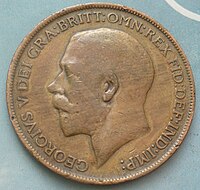
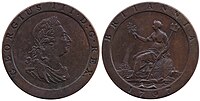
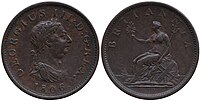
Images: Wikimedia Commons (CC BY-SA)
George V's 25-year reign encompasses some of the most collected British pennies, including the legendary 1933—Britain's rarest circulation-type coin. The series also includes World War I branch mint issues and two distinct portrait types.[2]
Portrait Types
First (Large) Head
Designed by Bertram Mackennal. Features a detailed portrait with pronounced beard detail. BM initials on truncation.
Modified (Small) Head
Slightly smaller portrait with modified hair and beard detail. Introduced for improved striking quality.
Branch Mint Issues (1912–1919)
During World War I, demand for pennies exceeded Royal Mint capacity. Private mints were contracted to produce coins, identifiable by mintmarks:[3]
| Mintmark | Mint | Location | Years Active |
|---|---|---|---|
| H | Heaton Mint | Birmingham | 1912, 1918, 1919 |
| KN | Kings Norton Metal Co. | Birmingham | 1918, 1919 |
Mintmark location: To the left of the date on the reverse.
The 1933 Penny: Britain's Rarest
1933 Penny
No pennies were struck for circulation in 1933—existing stocks from previous years were sufficient. However, the Royal Mint produced a small number (estimated 6–7) for ceremonial purposes: to be placed under foundation stones of buildings constructed that year.[1]
Known Specimens
- Royal Mint Museum
- British Museum
- Church of St. Cross, Middlesbrough (under foundation stone)
- Church of St. Mary, Patrixbourne, Kent
- Several in private collections
Value
When specimens appear at auction, they typically realize £100,000+. A 1933 penny sold in 2016 for over £72,000, and values have increased since.
Warning: Forgeries
Due to extreme value, forgeries exist—typically altered 1935 or 1938 pennies. Any claimed 1933 penny requires rigorous authentication by a major grading service.
Complete Date Run
| Date | Mintage | Rarity | Est. Value (VF) |
|---|---|---|---|
| 1911 | 23,079,168 | Common | £3–10 |
| 1912 | 48,306,048 | Common | £2–8 |
| 1912H | 16,800,000 | Scarce | £8–25 |
| 1913 | 65,497,872 | Common | £2–8 |
| 1914 | 50,820,997 | Common | £2–8 |
| 1915 | 47,310,807 | Common | £2–8 |
| 1916 | 86,411,165 | Common | £2–6 |
| 1917 | 107,905,436 | Common | £2–6 |
| 1918 | 84,227,372 | Common | £2–6 |
| 1918H | 3,660,800 | Scarce | £10–35 |
| 1918KN | Included | Scarce | £12–40 |
| 1919 | 113,761,090 | Common | £2–6 |
| 1919H | 3,660,800 | Scarce | £10–35 |
| 1919KN | Included | Scarce | £12–40 |
| 1920 | 124,693,485 | Common | £2–6 |
| 1921 | 129,717,693 | Common | £2–6 |
| 1922 | 16,346,711 | Common | £4–12 |
| 1926 | 4,498,519 | Scarce | £8–25 |
| 1926 ME | Included | Rare variety | £80–300 |
| 1927 | 60,989,561 | Common | £2–8 |
| 1928 | 50,178,000 | Common | £2–8 |
| 1929 | 49,132,800 | Common | £2–8 |
| 1930 | 29,097,600 | Common | £3–10 |
| 1931 | 19,843,200 | Common | £3–10 |
| 1932 | 8,277,600 | Scarce | £6–20 |
| 1933 | 6–7 | Extremely Rare | £100,000+ |
| 1934 | 13,965,600 | Common | £3–10 |
| 1935 | 56,070,000 | Common | £2–6 |
| 1936 | 154,296,000 | Common | £1–5 |
George V Penny Resources
Edward VIII (1936)
The King Who Never Was (On Coins)
Edward VIII reigned for less than a year (January–December 1936) before abdicating to marry Wallis Simpson. His abdication came before any coins bearing his portrait were released for circulation.[1]
Pattern Pennies
The Royal Mint did prepare pattern (trial) pennies bearing Edward VIII's portrait. These are among the rarest British coins:
- Designed by Humphrey Paget
- Edward facing left (breaking tradition of alternating directions)
- The King insisted on showing his "good side"
- Extremely few examples survive
Value
When pattern pennies appear at auction: £50,000+
Most known examples are in museums or major institutional collections.
George VI (1937–1952)
George VI's penny series introduced a new Britannia design and saw the coin through World War II and into the post-war era. Two key dates—1950 and 1951—make this series interesting for collectors.[2]
Design Details
Obverse Designer: Humphrey Paget
Reverse Designer: Humphrey Paget (new Britannia)
The reverse features a redesigned Britannia, seated right with trident and shield, lighthouse and ship removed for a cleaner design.
| Date | Mintage | Rarity | Est. Value (VF) |
|---|---|---|---|
| 1937 | 88,896,000 | Common | £1–4 |
| 1938 | 121,560,000 | Common | £1–4 |
| 1939 | 55,560,000 | Common | £1–5 |
| 1940 | 42,284,400 | Common | £2–6 |
| 1944 | 42,600,000 | Common | £2–6 |
| 1945 | 79,531,200 | Common | £1–4 |
| 1946 | 66,855,600 | Common | £1–4 |
| 1947 | 52,220,400 | Common | £1–4 |
| 1948 | 63,961,200 | Common | £1–4 |
| 1949 | 14,324,400 | Common | £2–8 |
| 1950 | 240,000 | Key Date | £25–80 |
| 1950 Proof | ~17,000 | Scarce | £15–40 |
| 1951 | 120,000 | Key Date | £30–100 |
| 1951 Proof | ~20,000 | Scarce | £15–40 |
Notes on 1950 and 1951
These low-mintage dates were struck primarily for inclusion in mint sets rather than general circulation. Most surviving examples are in better grades, making circulated pieces actually harder to find than proofs.
George VI Penny Resources
Elizabeth II (1953–1967)
The final pre-decimal penny series bears the portrait of Queen Elizabeth II. These coins remained in circulation until 1971's decimalization, when the old penny was replaced by the new half-penny.[1]
Design Details
Obverse Designer: Mary Gillick
Reverse: Britannia seated right (continuation of George VI design)
| Date | Mintage | Rarity | Est. Value (VF) |
|---|---|---|---|
| 1953 | 1,308,400 | Common | £2–8 |
| 1953 Proof | 40,000 | Common | £5–15 |
| 1954 | 0 (not struck) | – | – |
| 1961 | 48,313,400 | Common | £0.50–2 |
| 1962 | 143,308,800 | Very Common | £0.25–1 |
| 1963 | 125,235,600 | Very Common | £0.25–1 |
| 1964 | 153,294,000 | Very Common | £0.25–1 |
| 1965 | 121,310,400 | Very Common | £0.25–1 |
| 1966 | 165,739,200 | Very Common | £0.25–1 |
| 1967 | 654,564,000 | Extremely Common | £0.10–0.50 |
The Gap Years: 1954–1960
No pennies were struck for circulation between 1954 and 1960 inclusive. Existing stocks were considered adequate, similar to the situation in 1933. Unlike 1933, no ceremonial pieces were produced during these years.
The 1967 Surge
Over 654 million pennies were struck in 1967—by far the highest mintage in British penny history. The Royal Mint anticipated hoarding as decimalization approached and produced vast quantities. As a result, 1967 pennies are the most common of all British pennies and have minimal collector value except in pristine uncirculated condition.
Elizabeth II Penny Resources
The End of an Era: Decimalisation
On 15 February 1971—"Decimal Day"—Britain converted from pounds, shillings, and pence (£sd) to a decimal currency. The old penny (1/240th of a pound) was replaced by the new penny (1/100th of a pound).[1]
Pre-decimal pennies remained legal tender until 31 August 1971, valued at 0.416 new pence (5 old pennies = 2 new pence). Most were subsequently melted, though billions survive in collector hands and accumulations.
The decimal penny (officially "one penny" or "1p") continues today, though it too faces an uncertain future as cash transactions decline. The pre-decimal penny, however, lives on as one of Britain's most collected coin series.
Sources & Further Reading
- [1] The Royal Mint – UK Coins
- [2] Spink & Son – Coins of England
- [3] Coincraft – Standard Catalogue
- [4] NGC – World Coin Census
- [5] PCGS CoinFacts
- [6] Numista – Collaborative Catalogue
- [7] Freeman, Michael J. The Bronze Coinage of Great Britain – Essential variety reference