Introduction to Large Copper Pennies
The large copper pennies of Great Britain represent one of the most fascinating periods in British numismatic history. Spanning from the early Georgian era through the mid-Victorian period, these substantial coins witnessed the Industrial Revolution, the Napoleonic Wars, and the transformation of Britain into the world's dominant economic power.
These coins are characterized by their impressive size—ranging from 34mm to the massive 36mm "cartwheel" pennies—and their pure copper composition. Unlike the later bronze pennies, large coppers develop a distinctive chocolate-brown patina that collectors prize.[1]
Specifications Overview
| Period | Diameter | Weight | Composition | Mint |
|---|---|---|---|---|
| 1797 Cartwheel | 36mm | 28.3g (1 oz) | Copper | Soho Mint |
| 1806–1807 | 34mm | 18.8g | Copper | Soho Mint |
| 1825–1860 | 34mm | 18.8g | Copper | Royal Mint |
George III (1760–1820)
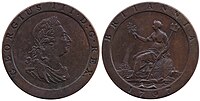
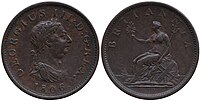
Images: Wikimedia Commons (Public Domain)
The Coinage Crisis
By the late 18th century, Britain faced a severe shortage of small denomination coins. The Royal Mint had essentially ceased copper production, leaving counterfeiters to fill the void. It's estimated that by 1797, over half of all copper coins in circulation were counterfeit.[2]
The Cartwheel Penny (1797)
The solution came from an unlikely source: industrialist Matthew Boulton and his Soho Mint in Birmingham. Boulton proposed a revolutionary approach—coins whose intrinsic metal value matched their face value, struck using steam-powered presses that could produce coins impossible to counterfeit economically.[3]
1797 "Cartwheel" Penny
Designer: Conrad Heinrich Küchler
Obverse: Laureate bust of George III facing right, date below
Reverse: Britannia seated left, holding olive branch and trident, shield at side
Edge: Incuse lettering: SOHO
Mintage: 8,601,600[4]
Why "Cartwheel"?
The nickname derives from the coin's massive size and the broad raised rim that resembles a wagon wheel. At exactly one ounce (28.3g) and 36mm diameter, these are the heaviest pennies ever produced for circulation in Britain.
Collecting Notes
- Condition: Most survivors show significant wear due to heavy circulation. Uncirculated examples command substantial premiums.
- Varieties: Look for differences in the incuse edge lettering and minor die variations.
- Value range: £30–80 (VG-VF), £150–400 (EF), £1,000+ (Uncirculated)
Later George III Pennies (1806–1807)
Following the success of the cartwheels, Boulton's Soho Mint continued production with a redesigned, lighter penny. These coins reduced the weight to 18.8g while maintaining high-quality production standards.
| Date | Mintage | Key Varieties | Est. Value (VF) |
|---|---|---|---|
| 1806 | Unknown (high) | With/without incuse curl on shoulder | £25–60 |
| 1807 | Unknown (high) | K on truncation varieties | £25–60 |
George III Penny Resources
George IV (1820–1830)
George IV's penny series marked a significant transition: the first pennies struck at the new Royal Mint facility on Tower Hill, which had opened in 1812. The Soho Mint closed following Boulton's death, and copper coinage returned to government control.[3]
Design Details
Designer: Benedetto Pistrucci (obverse), William Wyon (reverse modifications)
Obverse: Laureate head of George IV facing left
Reverse: Britannia seated right, date in exergue
| Date | Mintage | Rarity | Est. Value (VF) |
|---|---|---|---|
| 1825 | 1,075,200 | Scarce | £50–150 |
| 1826 | 5,913,600 | Common | £20–50 |
| 1827 | 1,451,520 | Scarce | £80–200 |
Collecting Notes
- The 1825 pennies often show weak strikes, particularly on the obverse laurel wreath.
- 1827 is genuinely scarce and underrated—a key date for the type collector.
- Proof examples exist and are rare; look for mirrored fields and sharp details.
George IV Penny Resources
William IV (1830–1837)
William IV's brief reign produced one of the scarcest regular-issue penny series. With the "Sailor King" on the throne for just seven years, mintages were generally low, making these coins particularly desirable to collectors.[1]
Design Details
Designer: William Wyon
Obverse: Bare head of William IV facing right, W.W. on truncation (some issues)
Reverse: Britannia seated right, date in exergue
| Date | Mintage | Rarity | Est. Value (VF) |
|---|---|---|---|
| 1831 | 806,400 | Scarce | £60–180 |
| 1831 W.W. | Included above | Rare variety | £150–400 |
| 1834 | 322,560 | Rare | £100–300 |
| 1837 | 174,720 | Rare | £120–350 |
Key Varieties
1831 W.W. on Truncation
Some 1831 pennies feature William Wyon's initials (W.W.) on the neck truncation. This variety commands a significant premium and represents the engraver signing his work—a practice that would continue on Victoria's portrait.
Collecting Notes
- William IV pennies are underappreciated relative to their scarcity.
- The 1837 is particularly rare—struck in the final months before Victoria's accession.
- Beware of harshly cleaned examples; original surfaces are highly prized.
- No pennies dated 1832, 1833, 1835, or 1836 were struck for circulation.
William IV Penny Resources
Victoria Copper Pennies (1839–1860)
Queen Victoria's early reign saw the final chapter of large copper pennies. The "young head" design by William Wyon ranks among the most beautiful coin portraits ever created, depicting the teenage queen in classical style with her hair bound up.[3]
Design Details
Designer: William Wyon (both sides)
Obverse: Young head of Victoria facing left, date below
Reverse: Britannia seated right, trident behind, lighthouse and ship in background
The Complete Date Run
| Date | Mintage | Rarity | Est. Value (VF) |
|---|---|---|---|
| 1839 | Proof only | Rare | £800+ |
| 1841 | 913,920 | Scarce | £30–80 |
| 1843 | 483,830 | Scarce | £50–150 |
| 1844 | 215,040 | Rare | £80–250 |
| 1845 | 322,560 | Scarce | £40–120 |
| 1846 | 483,840 | Common | £25–70 |
| 1847 | 322,560 | Scarce | £40–100 |
| 1848 | 161,280 | Rare | £80–250 |
| 1848/7 | Included above | Rare overdate | £150–400 |
| 1849 | 268,800 | Scarce | £50–150 |
| 1851 | 268,800 | Scarce | £40–100 |
| 1853 | 6,720,000 | Common | £15–40 |
| 1854 | 6,759,200 | Common | £15–40 |
| 1855 | 5,273,856 | Common | £15–40 |
| 1856 | 1,212,288 | Scarce | £30–80 |
| 1857 | 752,640 | Scarce | £25–70 |
| 1858 | 1,599,040 | Common | £15–40 |
| 1858/7 | Included above | Scarce overdate | £60–150 |
| 1859 | 1,075,200 | Common | £20–50 |
| 1860 | See bronze | Transitional | Variable |
Notable Varieties
1848/7 Overdate
A clear overdate variety where the 8 is punched over a 7. The underlying 7 is visible at the bottom of the 8. This is one of the most popular British copper varieties.
Detection: Look for a diagonal line extending from the lower loop of the 8.
1858/7 Overdate
Similar to the 1848/7, this overdate shows traces of a 7 beneath the final 8 of the date.
Detection: Best visible under magnification; look for doubling in the 8.
DEF: vs DEF. Varieties
Throughout the series, look for variations in the legend spacing, particularly whether there is a colon after DEF (Defender of the Faith).
Ornamental vs Plain Trident
The trident behind Britannia appears in two styles: ornamental (decorative prongs) and plain. Both are collectible.
The 1860 Transition
The year 1860 marks the end of the large copper penny and the beginning of the bronze era. Some 1860 copper pennies exist alongside the new bronze issues, making this a fascinating year for variety collectors. The copper 1860s are distinguishable by their slightly larger size and distinct color.[4]
Collecting Large Copper Pennies
Building a Collection
Large copper pennies offer several approaches for collectors:
- Type Set: One example from each monarch (George III, IV, William IV, Victoria)—achievable for most budgets.
- Date Set by Monarch: Complete the run for your favorite king or queen.
- Complete Date Set: Every date from 1797–1859—challenging due to scarce dates like 1827, 1834, and 1848.
- Variety Specialist: Focus on die varieties, overdates, and edge lettering types.
Grading Considerations
Large coppers present unique grading challenges:
- Surface preservation: Original chocolate-brown surfaces are highly desirable. Avoid cleaned or artificially toned examples.
- Strike quality: Many dates show weak central strikes; adjust expectations accordingly.
- Edge wear: The broad rims wore quickly in circulation; sharp rims indicate better preservation.
- Environmental damage: Copper is susceptible to verdigris and corrosion; avoid porous or spotted examples.
See our Grading Guide for detailed assessment criteria.
Authentication
For valuable dates and varieties, third-party grading from NGC or PCGS provides authentication and market confidence. Both services have extensive experience with British coppers.
Sources & Further Reading
- [1] Spink & Son – Coins of England and the United Kingdom – The standard British coin reference
- [2] British Museum – Coins and Medals Department – Historical context and specimens
- [3] The Royal Mint – UK Coins – Official mint records and history
- [4] Coincraft – Standard Catalogue – Mintage figures and varieties
- [5] A.H. Baldwin & Sons – Premier British coin dealers since 1872
- [6] Dix Noonan Webb – Auction records and realized prices
- [7] Peck, C. Wilson. English Copper, Tin and Bronze Coins in the British Museum, 1558–1958 – The definitive academic reference